Kingwood Underground
the heart and soul of our Kingwood, Texas family
Login - Create Account - Help
Clean out your garage on Kingwood bookoo! Or find local garage sales on Yard Sale Search.com
KU Live!

I thought it was a snake

who's talking here?

MonzaRacer 1
Ladybug 1
Tylers Journey 3
kimmer 1
Q The Rain in 5 4 3 2 5
SagaciousSighFiGurl 2
kapoocheeno 2
Hakuna Matatted 1

     » send to friend     » save in my favorites     » flag dangerous topic flag as a dangerous topic

Q The Rain in 5 4 3 2 --- 15 years ago -

I saw a pile of dirt and a big 2" hole dug into my flower bed. I thought it was a snake. I flushed it out with my hose this morning. Out flew one of those big-arse flying yellow striped things. It was the size of a small bird!! 

kapoocheeno --- 15 years ago -

We have one in our side yard this year. That flowerbed is getting neglected because I refuse to go near it. I can see them from the window. *shudder* 

Q The Rain in 5 4 3 2 --- 15 years ago -

You have a snake? :O My flowers would die if there was a snake living with them! 

SagaciousSighFiGurl (Mod) --- 15 years ago -

What the heck are those?? Got a pic?


On the subject of snakes..there's going to be a spot on the news tonite about why they are trying to get indoors right now...*shudder*. 

Tylers Journey --- 15 years ago -

We have one that is on the side of the house we leave it alone it never bothers us. This one is the size of my hand. 

Tylers Journey --- 15 years ago -

I think they are called Cicada Killer 

kapoocheeno --- 15 years ago -

You have a snake? :O My flowers would die if there was a snake living with them!

Not a snake, a Cicada Killer nest! It's horrifying!

0 

Tylers Journey --- 15 years ago -

That's what we have out back they don't bother us or the kids so we just leave them. 

Q The Rain in 5 4 3 2 --- 15 years ago -

I thought they liked dry soil? My flower beds are kept moist (for now).

0 

SagaciousSighFiGurl (Mod) --- 15 years ago -

Oh, ok, I've only seen a couple of those all summer. Maybe my dirt sucks. 

Q The Rain in 5 4 3 2 --- 15 years ago -

No, SciFi it means your dirt is moist. They dig into dry soil. I guess we can look at them as our moisture meters. 

Hakuna Matatted --- 15 years ago -

those things are scary! i had no idea what they were and just chalked it up to another TX bug that i'll get used to.

*shiver* 

Q The Rain in 5 4 3 2 --- 15 years ago -

I think if as long as you do not look like a cicada, smell like a cicada,or act like a cicada you are safe from these menaces of Earth. 

kimmer --- 15 years ago -

oh hell no! that bug is to big for me... ewwww I'd run screaming into the house. 

Ladybug --- 15 years ago -

I have several in my yard/garden. I thought they were hornets. Not sure. They hover near the ground and follow you, and make a tremendous noise with their wings. 

MonzaRacer --- 15 years ago -

Saw one fly by with a cicada the other day and right into his hole with it...


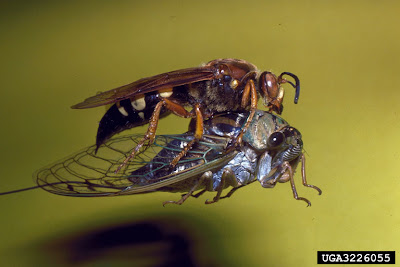
The cicada killer wasps attract attention due to their large size, the burrows that they dig in home lawns, and their buzzing flights over the lawn. These insects occur in all states east of the Rocky Mountains and prefer to dig their burrows in sandy, bare, well drained soil exposed to full sunlight. The wasps feed on flower nectar while the immature or larval stage feeds primarily upon cicadas that are brought to the burrow by the adult.

In spite of their large size, the wasps usually ignore people but they can give a painful sting if bothered. Mating males are aggressive and more easily disturbed.

A mound of fine soil surrounds the burrow of each cicada killer. Since colonies of burrows are common, infested lawns usually contain several mounds that can smother the grass. However, they prefer to nest in areas of sparse vegetation, and rarely infest thick,vigorous turf.

Cicada killers over winter as larvae in the soil. Pupation occurs in the spring and the adult emerges in mid-June to early July. Emergence continues throughout the summer. Females feed, mate, and dig burrows for several weeks before preying on cicadas. Excess soil thrown out of the burrow forms a regular, U-shaped mound at the entrance.

The females search tree trunks and lower limbs for cicadas. The wasp stings its prey, turns the victim on its back, straddles It, and drags it or glides with it to the burrow. Each cell is furnished with at least one cicada (sometimes two or three) and a single egg before being sealed off. Two to 3 days later the egg hatches. Depending on the number of cicadas in its cell, the larva feeds for 4 to 10 days until only the cicada's outer shell remains. During the fall, the larva spins a silken case, shrinks, and prepares to overwinter. Only one generation occurs each year.
 

page 1
Login to add your comments!

see more discussions about...


Online now:
hit counters

Terms of Service - Privacy Policy - Ice Box

Kingwood Underground